Jerusalem means so many things to so many people. Again, here is a time where I can’t even begin to summarize the blending of history and religion that makes this city such an interesting “being”. It really is its own being. I mean, I think you’d be really hard pressed to find anyone in the world that didn’t know of the town, many attaching some sort of deep meaning to it.
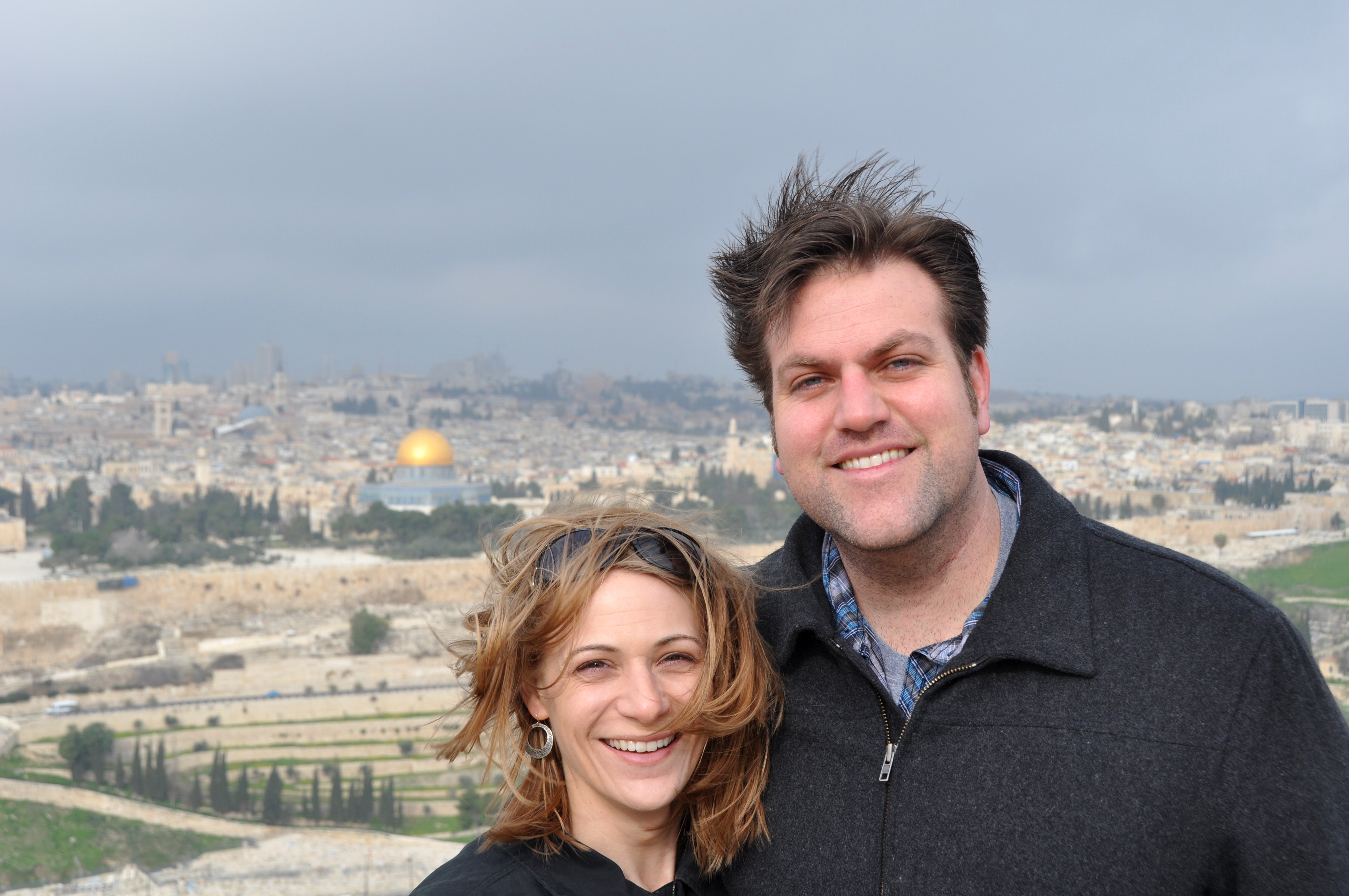
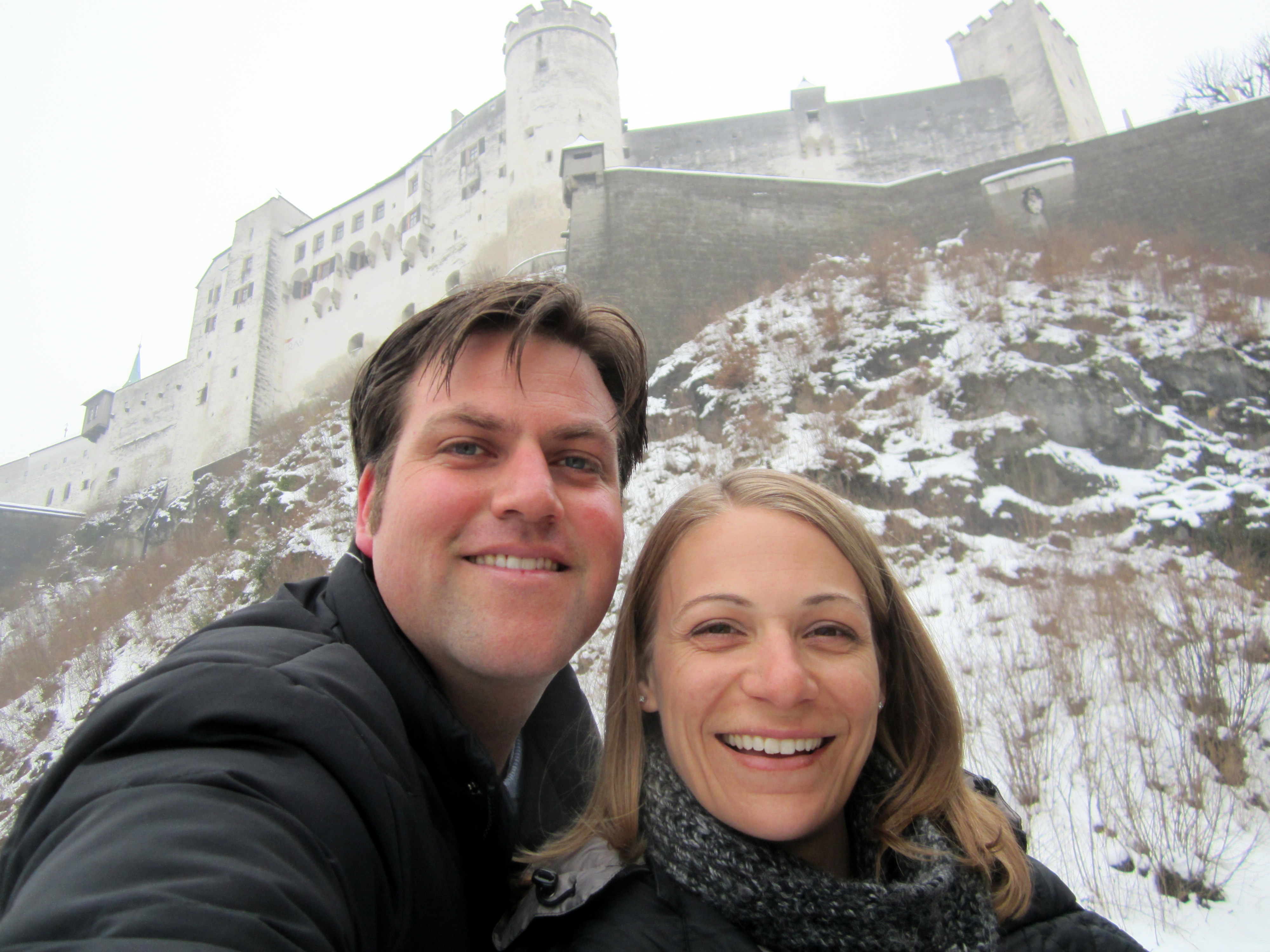
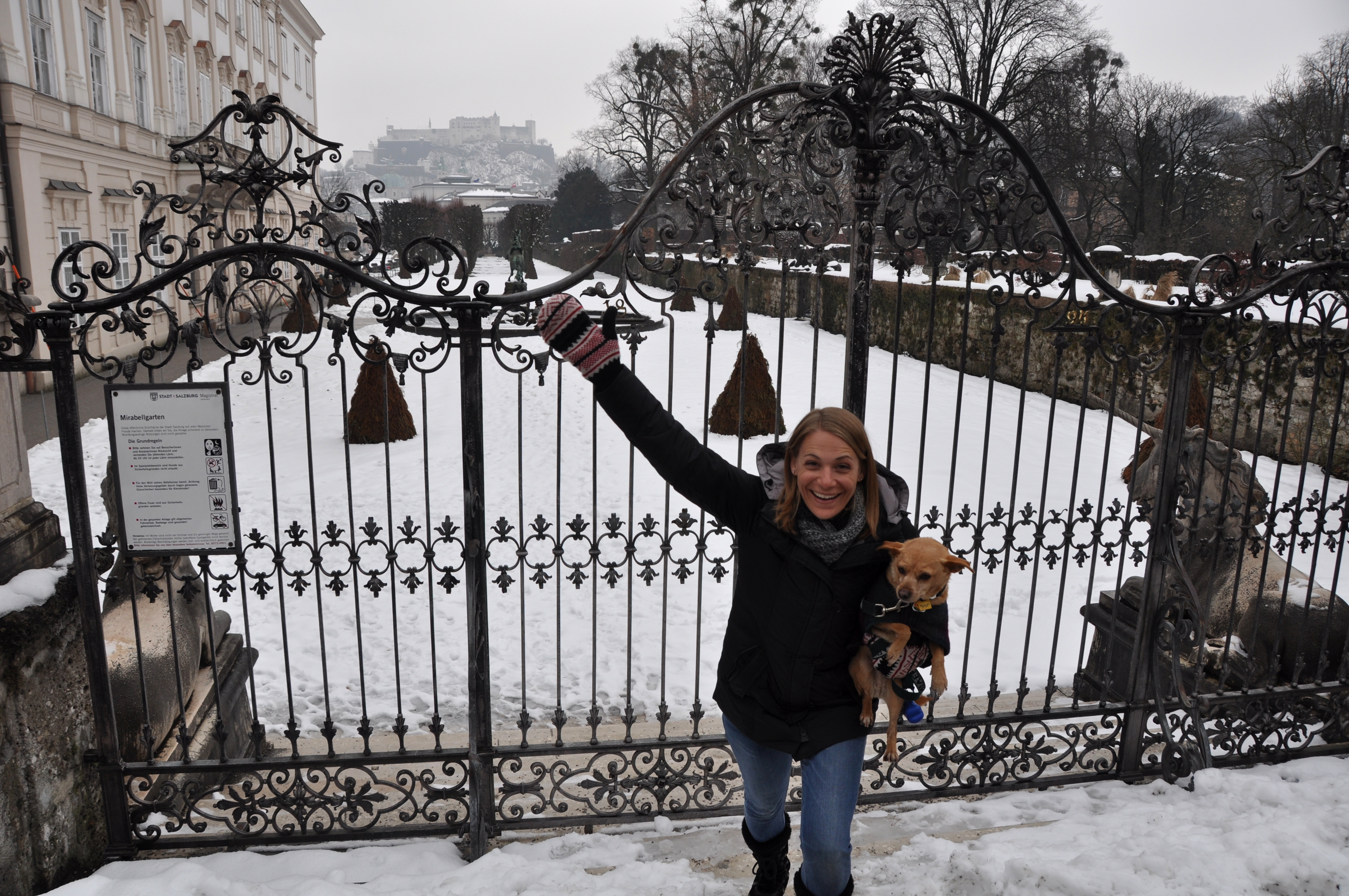
I worked all day getting my hair to do that!
So, yet again, I will focus on the highlights of our pilgrimage through Jerusalem and the impacts that these sights had on us.
Oskar Schindler’s grave – Our first stop for the day, Oskar is buried in the Catholic Franciscans’ cemetery on Mount Zion. In Jewish tradition, visitors to the grave leave rocks, paying homage to the risky acts that he performed during WWII saving more than 1,200 lives before he fled from Germany.
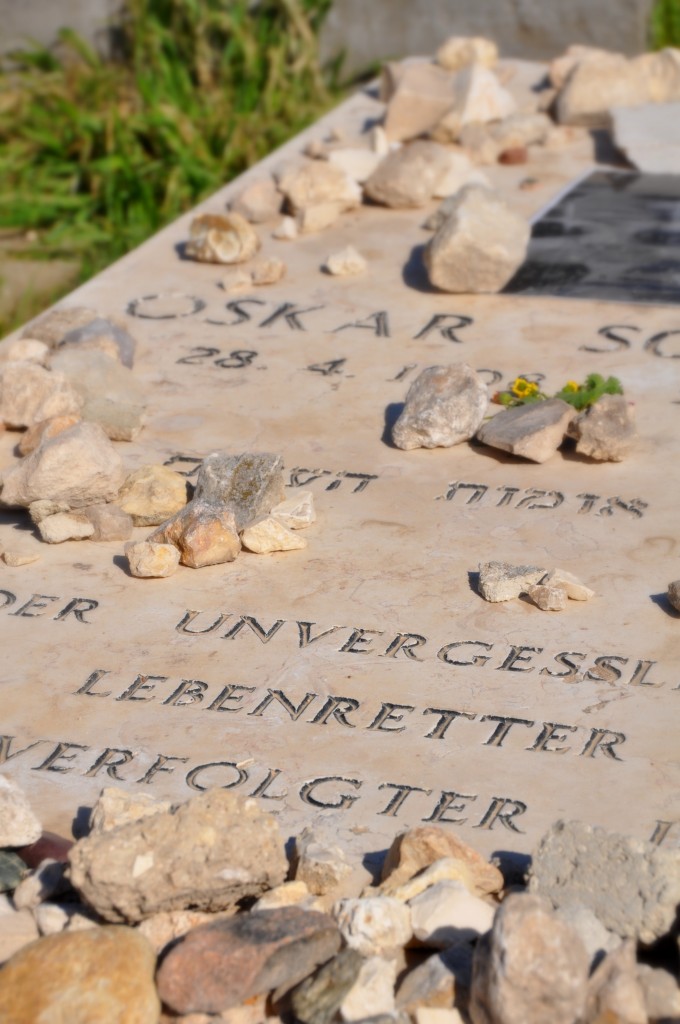
Oskar Schindler, Lebenretter (Life Saver)
The Western Wall – This wall is the only thing remaining of the destroyed Second Temple, and the most sacred site, outside of the Temple Mount itself, in the Jewish faith. According to the Jewish Orthodox faith, men are not allowed to see women pray, and thus there is a separation barrier keeping the genders apart.

View of the Western Wall from afar.
Joe and I had very different experiences on our respective sides of the barrier. On the women’s side, it was relatively quiet and peaceful. Only a woman in the corner was talking loudly to the small group she had assembled around herself. All the rest seemed to be in their own world, in their own prayers. With hands and forehead on the wall, I was suddenly overwhelmed by the noise. The noise that couldn’t be heard just a few feet back. The huge rocks seemed to echo the whispers and cries of those on both sides of me. I got lost in the sobs of my neighbor and felt the need to back away, as the intimacy was too much for me. I hope she found the comfort she needed at the wall that day.
The men’s side, on the other hand, was busy with song and dance, children and books. Joe was approached for money three times during the 15 minutes he was there. There were several similar displays of emotional prayers, but there was a lot of “work” going on. Many orthodox Jewish men spend their lives praying, many there at the Western Wall. He said it was definitely a sight to see.
Later that day, we actually saw a different segment of the Wall, tucked away behind several dark allies. Named the “Small Wailing Wall”, it is only about 10 meters long and situated in the back courtyard of someone’s house. There is a small barrier, behind which little girls carried their backpacks into their house and tourists stood to watch people praying. Despite its small size, the Small Wall is riddled with controversy, as there is no dividing wall for the sexes and the residents are fighting to have authority of their own courtyard, which just happens to be right along the Wall.
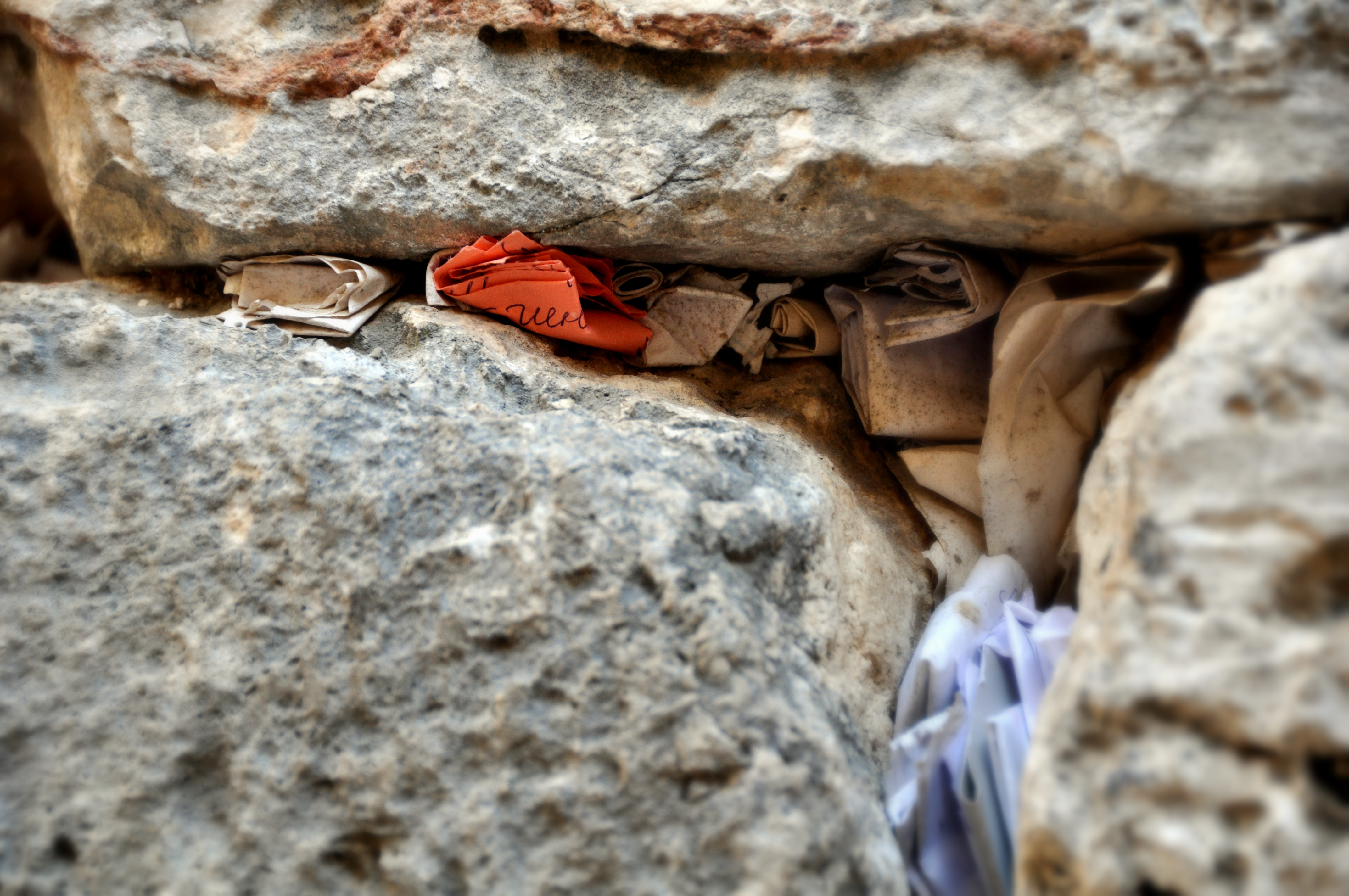
Prayer notes jammed between the rocks.
Temple Mount – The Temple Mount is a deeply complex and controversial site. Christians, Jews, and Muslims all attach very strong historical and religious meaning to the location. The Mount is controlled by the Muslims, and non-Muslims are permitted entry only during specific (and quite limited!) times each day. Early in the day, we were turned away from visiting by guards, but were “lucky” enough to have about 15 minutes later in the day. I say lucky because the site is only open for 1 hour in the afternoon and before entering you must go through security. Security opens at exactly the same time as the site, so if you are too far back in line, you have no chance. We arrived 30 minutes before the opening time to stand in line (which we were only about 100m from the start of), then spent 45 minutes getting through security, leaving us with 15 minutes on the Mount, 10 of which the guards were reminding us to leave the premises before closing time.
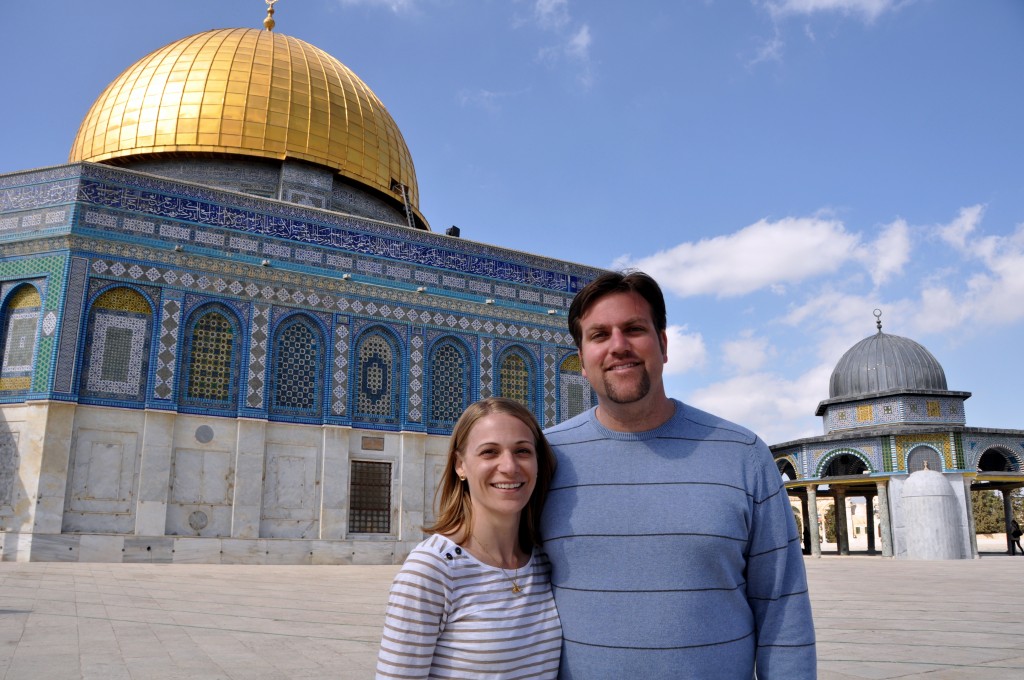
Dome of the Rock
Whew! Even those 15 minutes really showed us how challenging this site is, not only to comprehend, but also to manage. The interactions we had with other people while on the Mount seemed to be a true mirror of the complexity of this space on a historical, religious, and municipal level. There is no praying permitted on the Temple Mount, and all religious artifacts, tools, literature, or symbols are also forbidden, in an effort to keep the peace between all faiths. As we were walking through the site, our tour guide was taken aside and questioned by some guards. He was still wearing his kippah, and after what seemed like a really long time, he removed it, placed it in his pocket, and returned to the group. Apparently he has been wearing his kippah on the Temple Mount without incident for more than 7 years. Today marked the end of this. Later, while standing in front of the Al-Aqsa Mosque, a man began to loiter near the group and eavesdrop on what our guide was saying. This man then interrupted, told the guide his information was wrong, provided the “correct” facts, and then moved on. To what extent did the fact that our tour guide was Jewish and sharing information to tourists about Islam, all within earshot of a Muslim, play into the interaction is unknown. I don’t think anyone can know.
I must say though, our guide acted very professionally. He thanked the man, explained to the group the discrepancies in their two historical/religious knowledge bases, and then said, “I will look that up when I get home. I couldn’t possibly know everything, but I have learned something today as well, not just you all. Lucky me!”
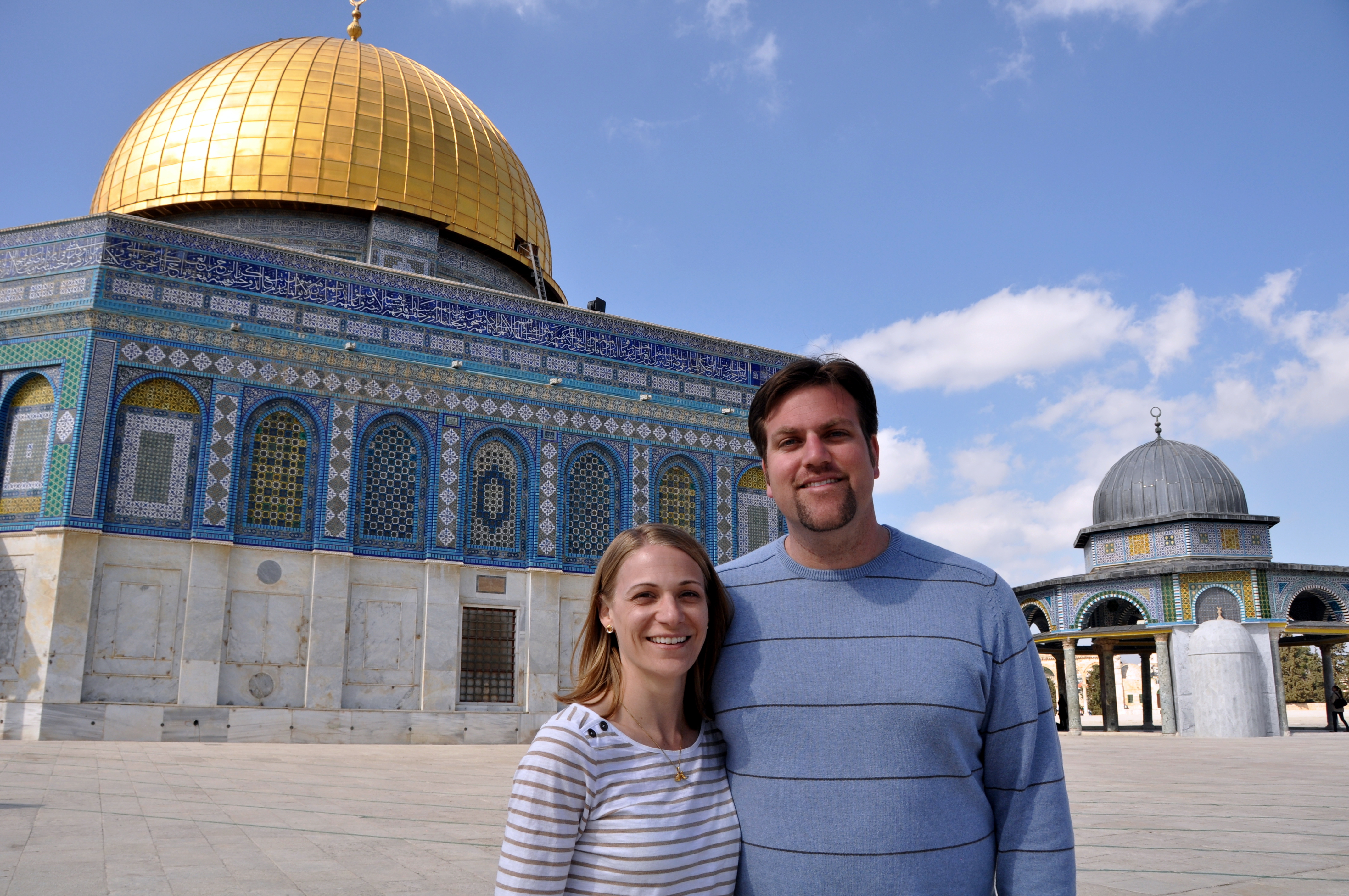
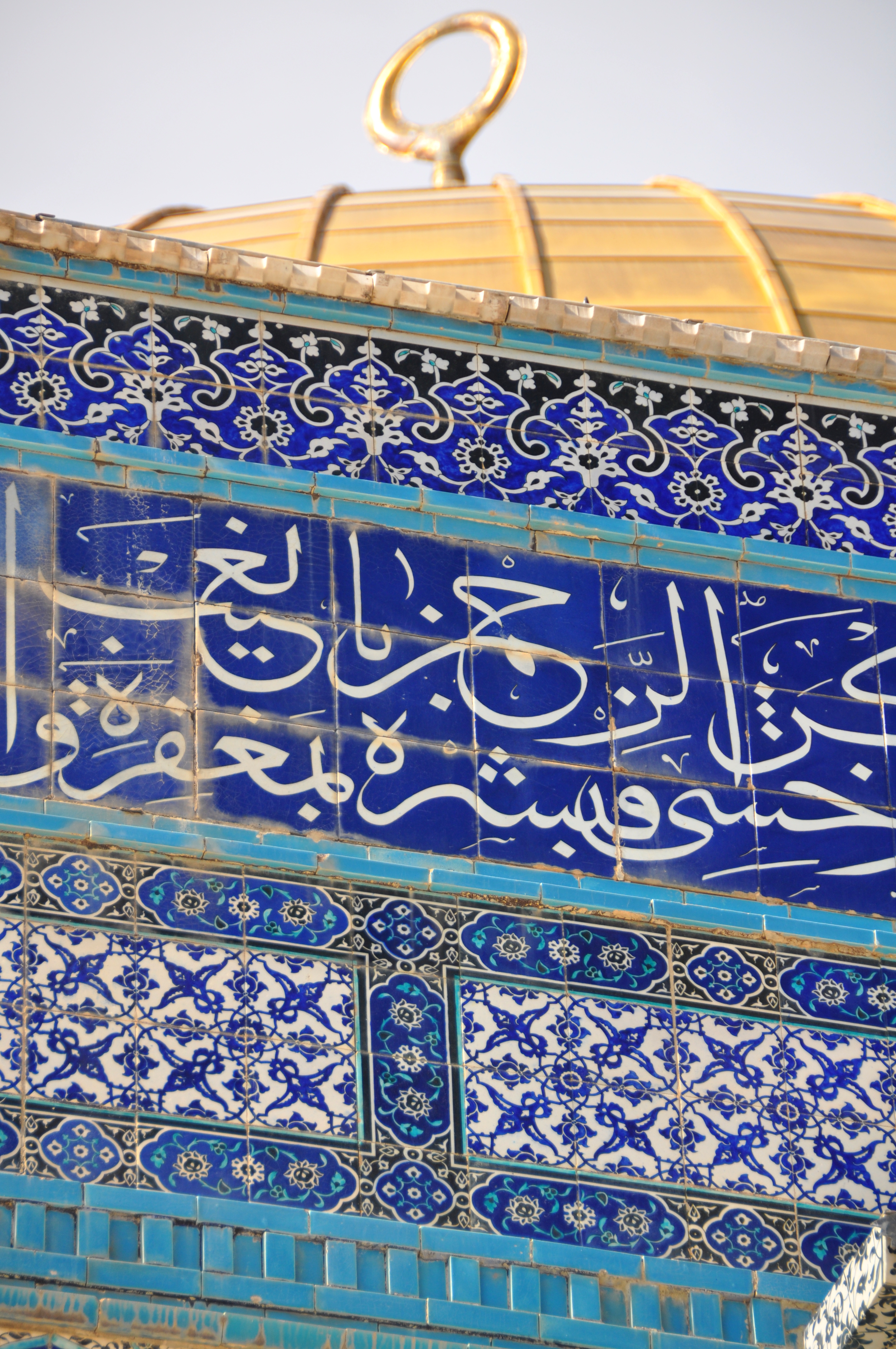
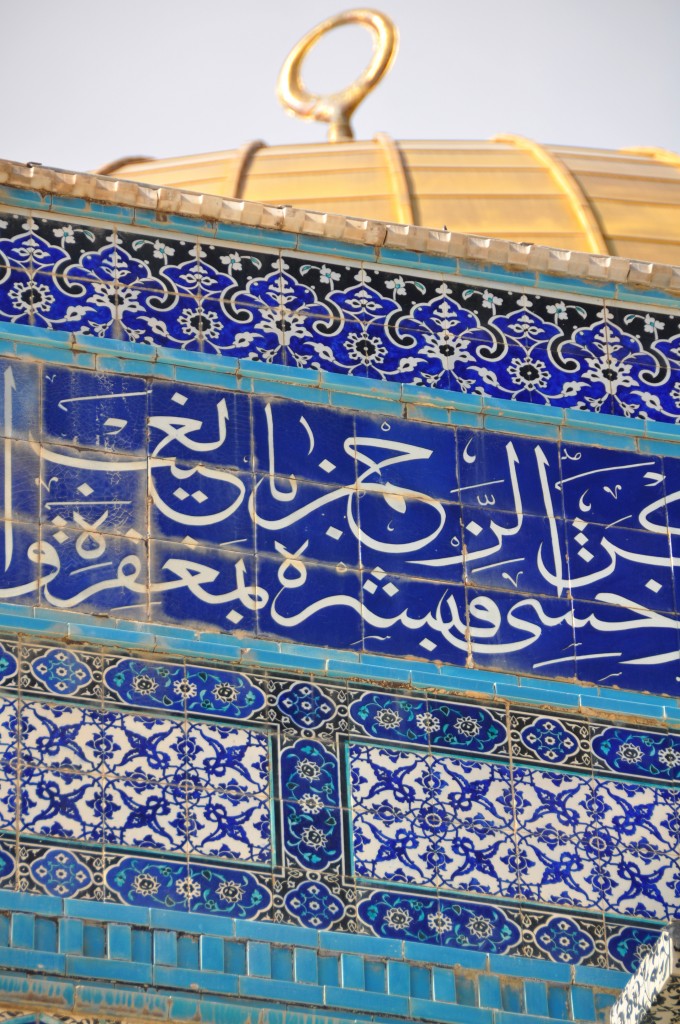
The Dome of the Rock is a beautiful building. Gilded in gold and covered in colorful tiles, it looks so different when you get to look at it up close. These tiles have been recently refurbished. There is only a small portion of 1,300 year old tiles located under one of the curved entrances.
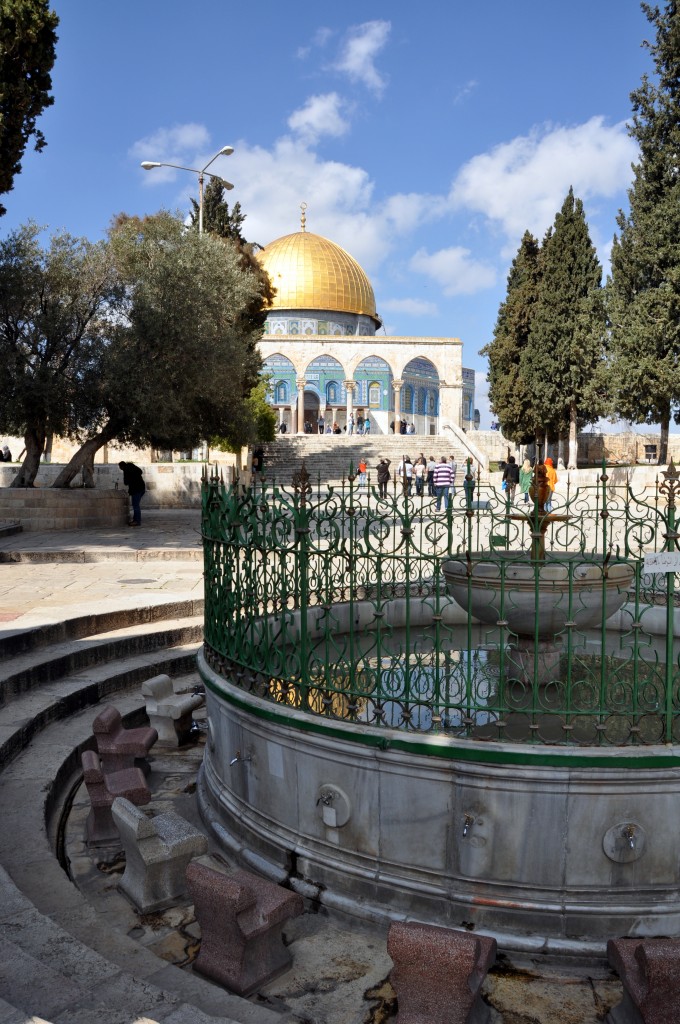
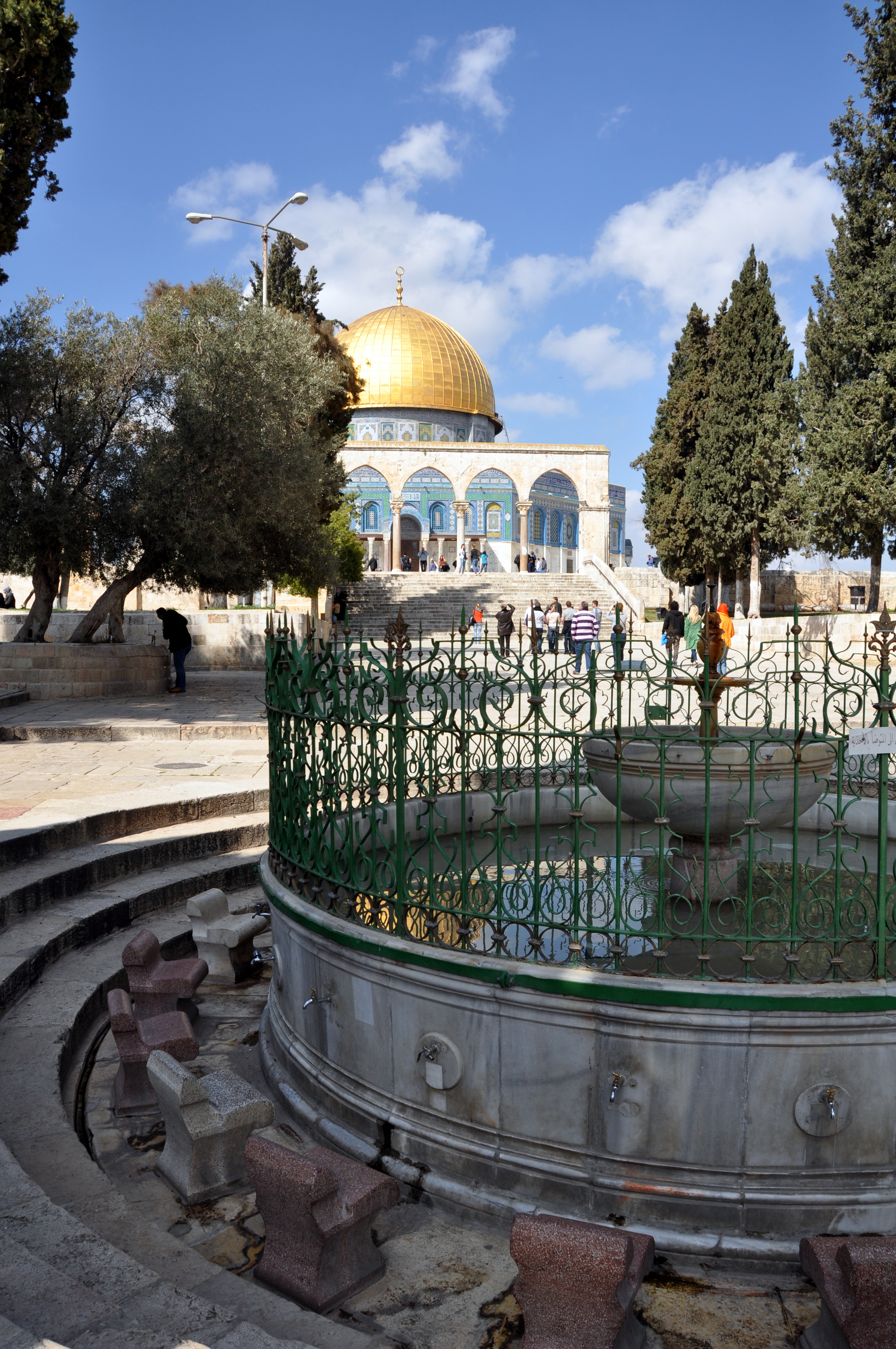
Muslim foot washing station outside the Dome of the Rock.
The “possible” sites – I have never heard the words “proposed”, “supposed”, “hypothesized”, “potential”, “traditional” or “believed”, used as frequently ever before in my life, as when talking about the Garden Tomb and the Church of the Holy Sepulchre. After visiting the Garden Tomb, I was convinced it was the site of the crucifiction, burial and resurrection of Jesus. Then, we visited the Church. I still don’t know which one I believe is the “possible” site.
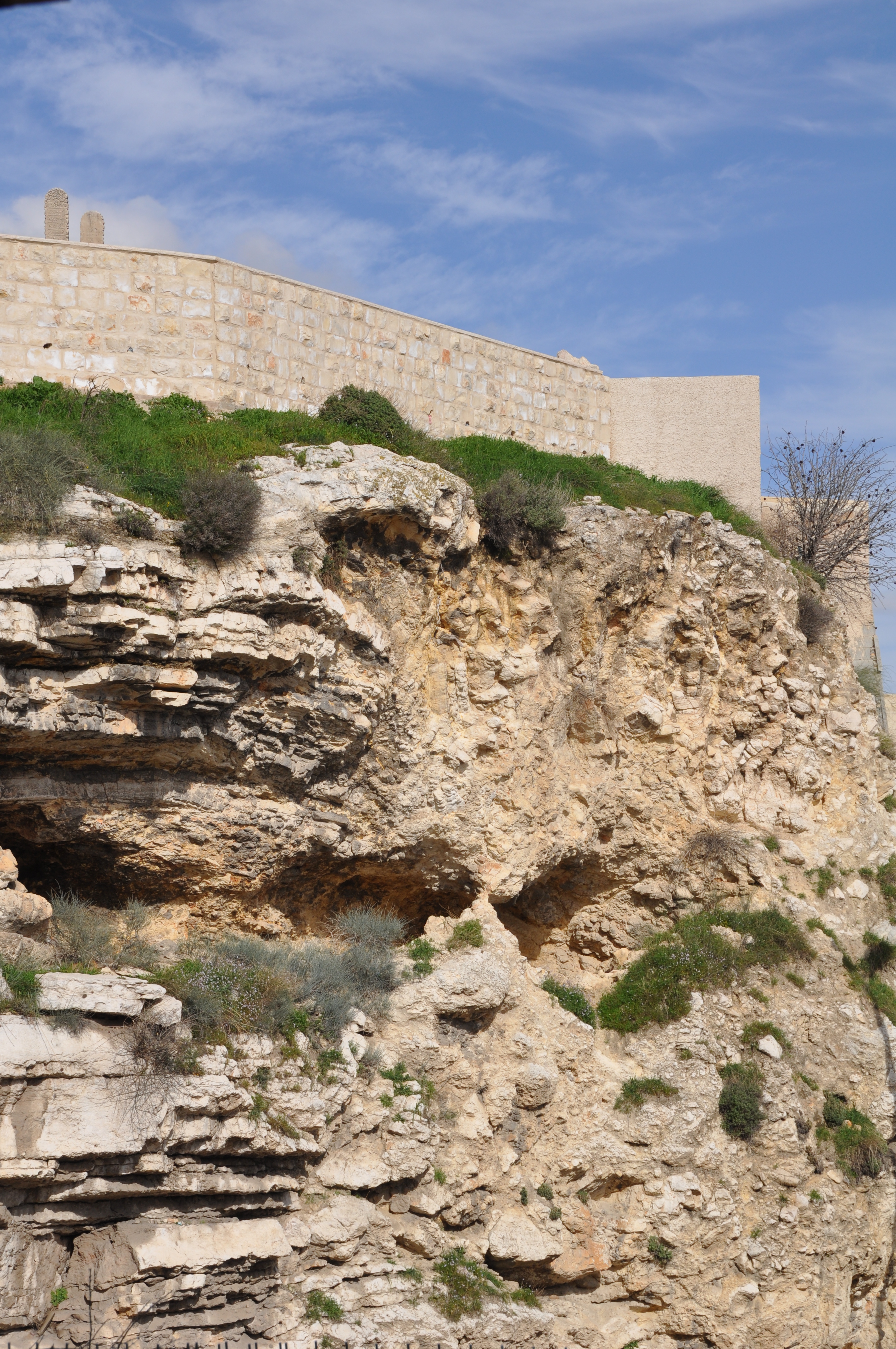
The two places are so different from each other. The Garden Tomb is exactly that, a peaceful garden where people sit in breezy corners to pray or reflect. There is a tomb, a wine press, and a rocky escarpment of the “possible” Golgotha (Skull Hill). It seemed more open here, exposed to the elements, less crowded. There was more space to breathe.

Skull-like appearance of what could be Golgotha.
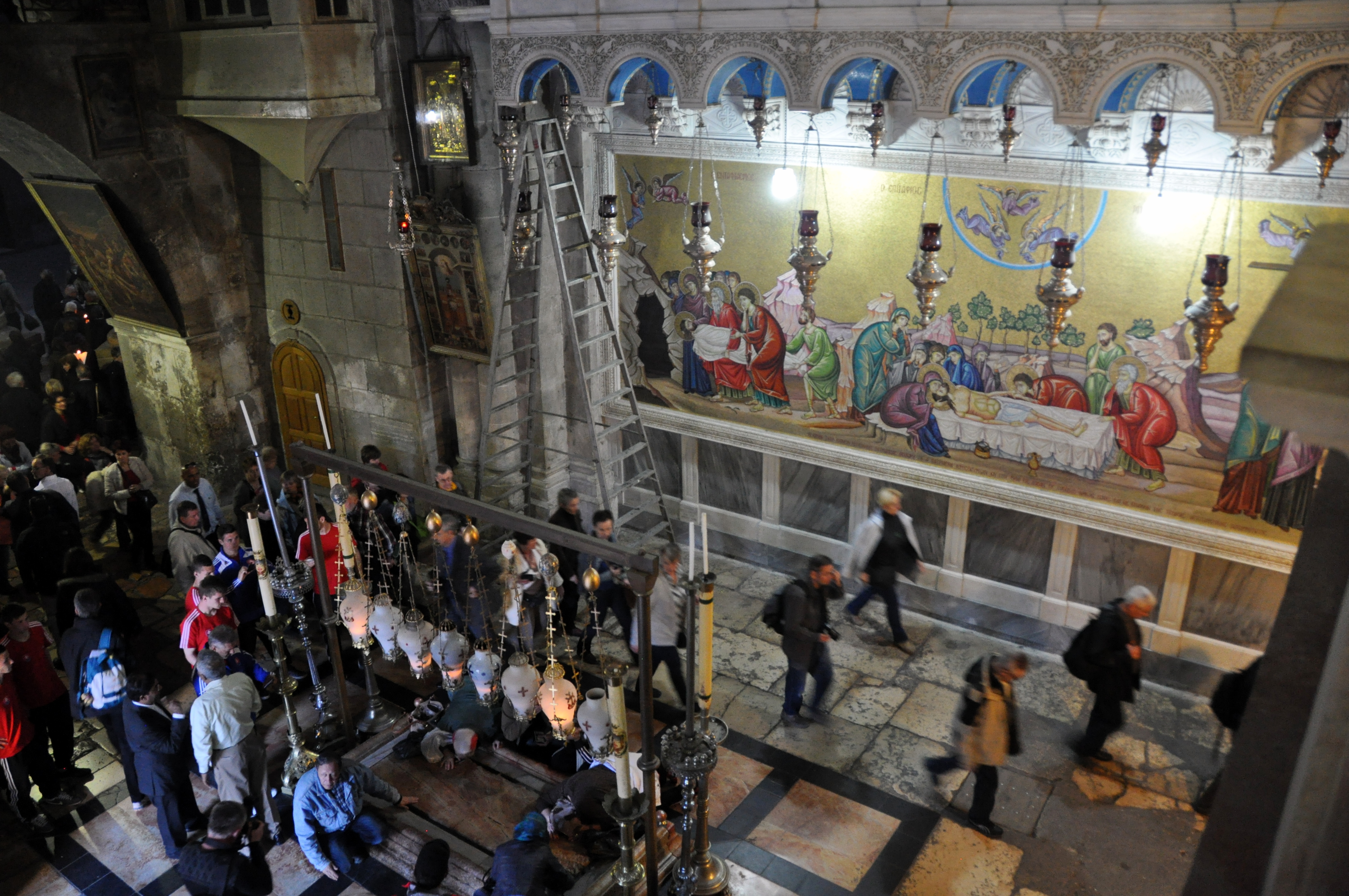
The Church of the Holy Sepulchre is also exactly that, a church filled with alters and mosaics, the strong scent of incense and dampness. Groups of people sang in various languages as they waited to pray at the Aedicule/Edicule (structure enclosing a tomb). We were ushered in small groups into the Aedicule and briskly reminded by the Orthodox Priest to move out if we hesitated for more than a few seconds. There is The Rock of Calvary, Crusader graffiti, The Stone of Anointing, and the Holy Sepulchre itself. Despite the darkness, the cacophony of so many people, and the thick air, there is a power to this place.
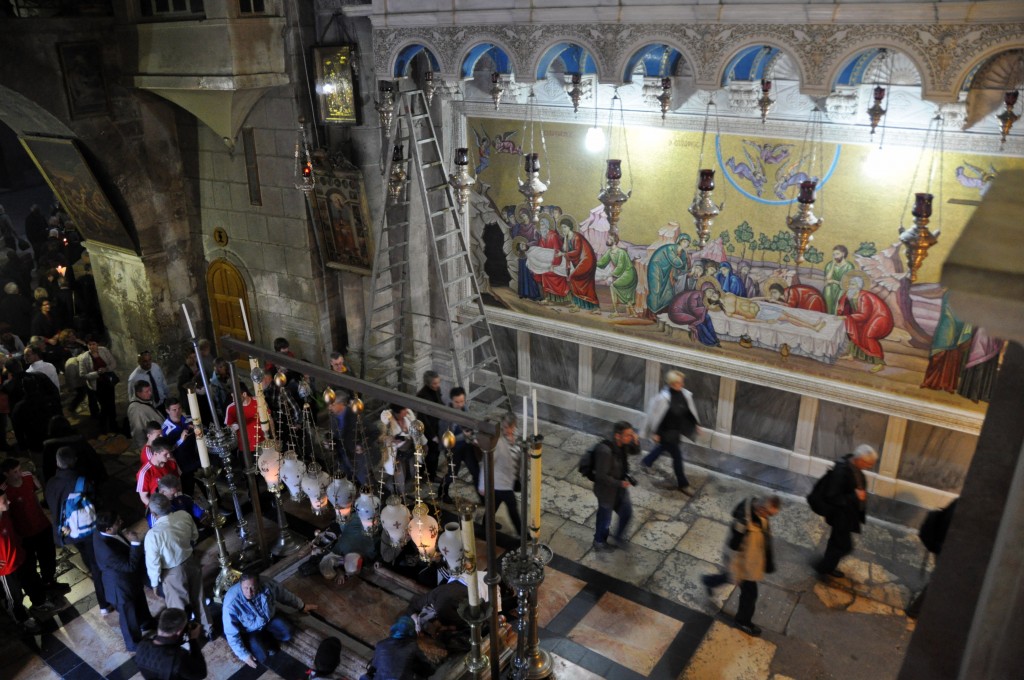
The Stone of Anointing and beautiful mural. Don’t walk under the random ladder, it brings bad luck.
With so many “supposed” sites, all of which are susceptible to contradicting evidence and studies, one can easily get lost between all the ifs, ands, or buts. Again, our guide had a really enlightening way of addressing the challenging question of: Where did it all really occur? His response: Does it really matter? No, it doesn’t. Let the world of religion decide. Like so many things in life, there is no right or wrong here. Let your chosen God lead you to the place where you can most strongly hear His voice, be it the Garden Tomb, the Church of the Holy Sepulchre, or the bench in your backyard.