Dachau & Oktoberfest

The Walls are still awaiting household goods, and this is what we have in our possession at this point: one air mattress, two travel blankets and two travel pillows, two ceramic bowls, +/- 100 paper plates, two folding chairs, one dog, three dog beds, and the clothes we could fit into two suitcases.

So, thank goodness for our friends in Munich, who were willing to take us in and give us a real bed to sleep in for a few nights and lots of great conversation for several rainy days! What a wonderful reprieve from the monotony of empty rooms and the challenges of daily decisions: Should we sit on the floor or the folding chairs? Should we save this paper plate or re-use it?

I don’t have my book because it is somewhere, in a box, in a crate, on some sort of transportation apparatus, at an undisclosed location anywhere between Freiburg, Germany and Cherry Hill, New Jersey. However, one of these Munich institutions has got to be in there.

Dachau Dachau was the first concentration camp of the Third Reich, established in March of 1933, just 51 days after Hitler became chancellor. It was the only camp to have existed throughout the entire twelve years of Nazi rule. The statistics are sobering – barracks made for 200 were housing 2000 by 1944, more than 32,000 documented deaths in total – all of it going “unnoticed” by Dachau residents and certain German and foreign officials. It is unreal. Until, one stands in the crematorium, takes a deep breath, and lets the weight of thousands of tortured souls settle in the mind and heart.

The question is: How could so many people have thought it was ok, albeit right and civically responsible, to kill thousands of individuals based on their religious beliefs?

The only answer I could conger after our visit: Words.

After World War I, around 1929, the world economic crisis set in and Germany was struggling with unemployment, starvation, and economic depression. They needed a savior. They needed hope. Here enters Hitler, who used debt flotation to begin the construction of dams, railroads, and other civil works. Unemployment began to decline and Hitler spoke the words that Germans needed to hear to re-establish hope in the future. He promised the people that their country would return to its pre-WWI status. Granted, his methods of doing this included forcing women out of the workplace, genocide, and other crimes against humanity via extreme dictatorship. However, his words were so powerful, convincing, and motivating to a desperate population, that he soon persuaded the citizens it was their duty to rid Europe of Jews.

The chosen words of Nazi propaganda methods are still tangible at Dachau. Their irony almost punches visitors in the face. In wrought iron, the entry gate that every prisoner passes upon admittance to the camp reads: Arbeit Macht Frei “Work will set you free.”  Jews, beggars, homosexuals, and Jehoviah’s Witnesses are told that “Hygiene is your responsibility. Don’t forget to wash your hands.” The water is poison. The souls are so desperate, and the words so convincing, that compliance is not a question.

Words convince the citizens of Dachau to ignore the putrid stench of death that constantly lingers over the town. Words convince German and foreign officials that residents of the camp are kept in good health and given due process. Words convince Jewish prisoners to work countless hours on armaments that will be used to kill others just like them, and build barracks that will be the last resting place of fellow “political prisoners”.

Words can be erased, ripped up, burned, or deleted. However, they are seldom forgotten and their impact lasting. Words change history.

Oktoberfest  Now- this is the Munich that everybody wants to see. Oktoberfest is the yearly celebration of Prince Ludwig’s marriage to Therese of Saxony-Hildburghausen, Queen of Bavaria, in 1810. Seven million people flock from all over the globe to partake in this wedding reception. Until 1994, it was actually held in the month of October; however, weather conditions are more favorable in September, also allowing the festival to end on the German Reunification holiday (giving everyone an extra day to recuperate).

At its core, Oktoberfest is a county fair: carnival rides, food and drink tents, games for prizes, souvenirs galore, and all types of people wearing all kinds of garb. In reality, Oktoberfest is the world’s most amazing county fair. And this statement comes from a non-bear drinker!

The festival takes place in Munich’s fair grounds, Theresienwiese. The same location where other festivals are held throughout the year, and when empty, is simply a cement slab. However; what is created on this cement slab is no small feat. Each beer “tent” is more like a mini convention center. There is a stage in the middle which holds a band of 20+ people, hanging chandeliers the size of dinner tables, functional kitchens which probably dole out dozens of rotisserie chicken every minute, seating for thousands, and get this….real toilets….with scrubbers. Not a porta-potti in sight! That is just the inside. Outside, the tents are decorated in Bavarian style: functional clock towers, multi-story facades with real windows and balconies, flowers and flags galore. I really can’t even explain it. It is truly amazing. The best part: outside each tent, each brewery has a cart of over 25 wooden barrels pulled by 6-8 draft horses wearing their Sunday best. They stand patiently, waiting to greet revelers, and show off their digs!
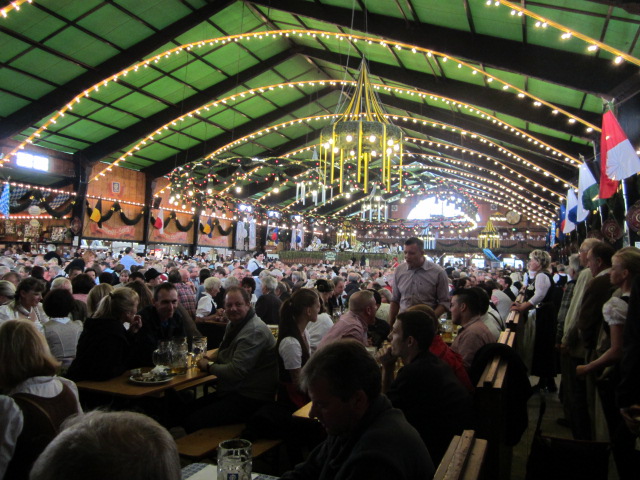
Ahhhh….now onto the food and drink! Not being a beer drinker myself, the thought of knocking back a full liter of heady brew feels about as exciting as oral surgery. However, with a fresh pretzel the size of my face, obazda, a warm rotisserie chicken, and some sausage and mashed potatoes, the suds go down like water! I heard rumor of a tent that was exclusively wine and sweets. Next year, that will be the first stop!

I read a book about a man who traversed Ireland searching for the best pint of Guinness. The conclusion he came to is that it was the people and the place that made each of his pints taste a little different, and a little better. If the same holds true for Germany and its beer, than Oktoberfest is the place to be! A bit of Gemütlichkeit goes a long way.

die Toilette

The purpose of this blog is to document my quest for 1000 Places throughout Europe. Traveling all over this continent is romantic and wonderful and all, but unfortunately we are not at that stage yet. We are at the how to read road signs in German so we can pass the test stage, the how to close down the city street to get our household goods into our apartment stage, and the what category of the multi-faceted German trash system does dog poop fit into stage. To be perfectly honest, we are also in the how to adjust to German toilets stage. The romantic travels will come….in due time. Toilets must be de-mystified…now.

When Joe and I came to Germany in May to find a place to live we stayed with the current Olmsted scholars in what would eventually be the “flat” we would occupy ourselves. I noticed that both of the bathrooms had toilet-bowl cleaners in plain sight. Personally, I think toilet-bowl cleaners are gross, and I always hide mine away, but whatever. I didn’t pass another thought about these things until we arrived in Germany eleven days ago.

German engineering of toilets is clearly not as good as cars. Anything you put in the toilet leaves evidence, even after a flush. The Walls have always been a seat-AND-lid-down-when-finished family. This habit did pay off at our first domicile – the Stuttgart Army Post hotel- where we stayed for about a week to in-process. Most of the time the evidence went undocumented because everything was covered; however, when it was time to “go”, there was a guaranteed surprise!

Married couples share a lot of things, but I didn’t really feel like sharing everything. Several days into our stay, I had to initiate a conversation with Joe, because there was no hiding what was occurring in the toilet (this is by no means placing blame on any one person. Everyone falls victim to the unfortunate design of European toilets eventually!). It came to a point where I was trying to figure out how I could go to the bathroom without ever opening my eyes. First, there was the squinting experiment. Then, I tried to prep outside and hurry-up inside, which is only practical for private settings. I also tried the completely-dark-visit, which is just plain dangerous. No solution found.

After leaving Stuttgart we moved on to Kaiserslautern. Our friends here also had toilet bowl cleaners right beside the toilet. Ok, my apologies for ever passing judgment about where a family chooses to house their toilet cleaning utensils. I get it now. In a restroom later that day I found a sign posted that read, “Scrub when Done”. Oh, the weight that was lifted off my shoulders, realizing I was not the only person struggling with the Porcelain Gods. Knowing that it is best to do unto others as I would have done unto myself, I did my civic duty and scrubbed. The sign finally made “potty talk” public knowledge and an open topic for conversation!

From Kaiserslautern we reached our final destination of Freiburg. The first day was jam-packed with logistics and a stop to the WC (water closet) was in order. You must know that my conversations regarding lavatories led to some important information and invaluable opportunities to learn from others’ mistakes. My friend accidentally sent her daughter into the wrong bathroom because she confused the words Damen (ladies) and Herren (gentlemen). The poor girl saw a urinal inside and made a 180 for the door.

So, Joe and I came across some public restrooms with Damen and Herran signs and choose correctly, newly armed with basic vocabulary. How surprised we were to find each other again on the other side of the doors! Inside the stall there was no hook to hang your purse, and there was no way I was going to put my bag down on the bathroom floor. Now I had an entirely new challenge to work through: how to hold onto everything in my hands whilst taking care of business in the public bathroom. At the resolution of this personal debacle, I looked around to complete my “scrub when done” duties. There was no scrubber! Oh my….would my newly-found ritual go uncompleted?! Walking away I found myself overly concerned with the inability to remove all evidence that I had ever stepped into the bathroom. Was I really passing judgment now at the lack of toilet bowl cleaner in plain sight? I think I was!

Moral of the story. When you come to my flat inGermany: don’t judge, just scrub.

die Französisch

So, is it possible for the French think I am a snob? This will probably be a “I guess you had to be there” story, since there is no conceivable way I can convey the accents and communication challenges that are in play during this lengthy interaction with some Frenchmen.

Our landlord has returned toJapan, so she arranged for her friends to walk through the flat with us, sign the papers, and hand over the keys. Here enter the French.

Joe and I park the car and have to bring Liv with us because…well…we are homeless and have nowhere else to put her. We meet the French couple outside and introduce ourselves, as well as Liv. There is some important back-information to know here: When we put Liv in the kennel, we always sign her up for a grooming session on the day that we are going to pick her up. Our kennel gives a free night when you have your dog groomed, and the grooming is cheaper than the price of one night, so we save a whopping $2 and get a clean dog! One of the girls at the kennel really took a liking to sweet Liv and started putting a bandana and matching stick-on earrings on Liv’s ears when she is finished grooming her. This particular pair of earrings has managed to stay on since we left Jersey.

Back to the street scene: Mrs. French pets Liv and asks about her earrings. I try to explain that the groomer likes to put those on her. “Oh, so the dog has her own personal coiffeur?” she asks, as she mimes looking in a mirror and sweeps her other hand around her hair. “No, no,” I try to explain, “it is where we keep her when we are away.” She smiles, but I am unsure if it is because she doesn’t understand, is still trying to understand, or understands clearly and thinks I spoil my dog.

The four of us (+ Liv) start to walk around and inspect the flat, logging any damages and imperfections that are present prior to our acquisition. Here is some more information needed to help this situation make sense: our flat building was originally French barracks from one of the many times  the town was either owned or occupied by the French (the exact date is still a mystery). We have the entire floor, because our landlord purchased both flats and knocked down the wall between. It is basically one really long hallway with all the rooms branching off. The French couple lives in a building of the exact same design and lay out, at the end of the same street. As we are walking down the hall together I say to Mrs. French, “This is quite a hallway.” She laughs and says, “Yes, you will need roller skates to get down this hall. You are lucky; we have our three children and only half the flat.” Time for me to open mouth, insert foot. I quickly ask questions about her children to divert the conversation away from the fact that we have twice the space, less than half the people, and are still concerned with how to fit everything in!

Move the scene to the cellar, an hour and a half later: We had purchased numerous European appliances from the previous tenants, since they were moving back to the States. These were all being stored in the cellar. As Joe is going through the items he says, “Here are your three hairdryers, Trysta.”  Mr. and Mrs. French look at me….I have nothing to say. Thank goodness for Joe’s quick wit, because he made some jokes about needing to dry his own hair.

Finally, we are looking at the electricity counter and the couple is explaining how we will be billed. Mr. French keeps saying “how much you conceive” instead of “consume” and I smile and nod as if it is perfect grammar. Mrs. French, though, recognizes the error and says “con-SU-may-tion”. More nods, and ja (yes)….ja (yes). This then leads to a conversation about the word “refrigerator” and Mr. French things is it so funny how we, the Americans, say refrigeraTOR. He does his best to mock our accent and Joe returns the favor with a “re-fregh-urgh-reigh-atore”. Ahhh…chuckles all around.

After two hours of sticky, exhausting attempts at communication, all the papers are signed and we are left with 20 keys to the flat. No exaggeration here. Twenty…as in 2-0. Joe and I stand alone, in the long, empty, hallway, hands full of keys, and just look at each other. There is minimal energy left for talking.

Some time later, after wrapping my head around the whole thing, my only lingering concern is: I think the French think we’re snobby!