
die Kuckucksuhr

There are some things in life that you know you just have to do, regardless of how you really feel about them. Owning a Cuckoo Clock was one of these things for me.

I have always found them kind of unattractive. May I even say garish? I also knew that a Cuckoo Clock would require care – daily re-setting of the weights, dusting, hourly ear-covering, etc. My wind-up Mickey Mouse wrist watch was taken away when I was a kid because I didn’t take care of it well enough. On several occasions I have watched my Mom get up every half hour for an entire day just to re-set our Grandfather clock. How in the world could I be responsible for the up-keep of a Cuckoo Clock? I wasn’t particularly in the mood for a high-maintenance time piece. Joe, however, has been looking forward to picking out the perfect Cuckoo for months now.

Instead of waiting (and dreading) this necessary step in life, I jumped right in a planned an entire day of “clocking” in the Black Forest. If more than two hours for this task seems excessive to anyone, let it be known that throughout southern Germany, there are over 200 miles dedicated to clocks on the Deutsche Uhrenstraße (German Clock Street). One day seemed appropriate. It turned out to be a great day!
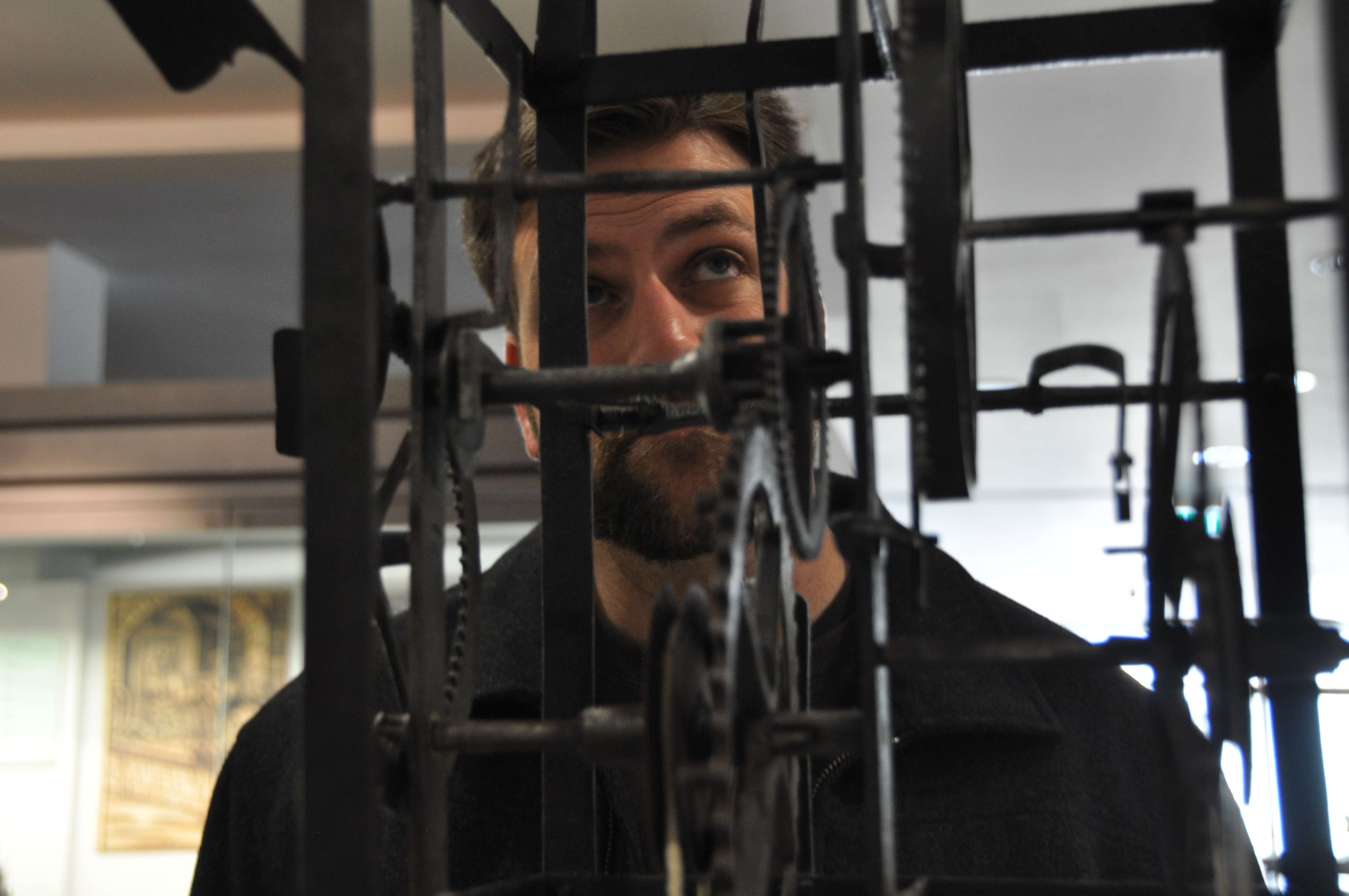
First stop was the German Clock Museum in Furtwangen. Big clocks, little clocks, Cuckoo Clocks, watches….you name it…it was about clocks. The best moment was when the musical clock room came to life unexpectedly. What good is a Saturday without a little song and dance in the clock museum? (Yes, we really did a little jig.)
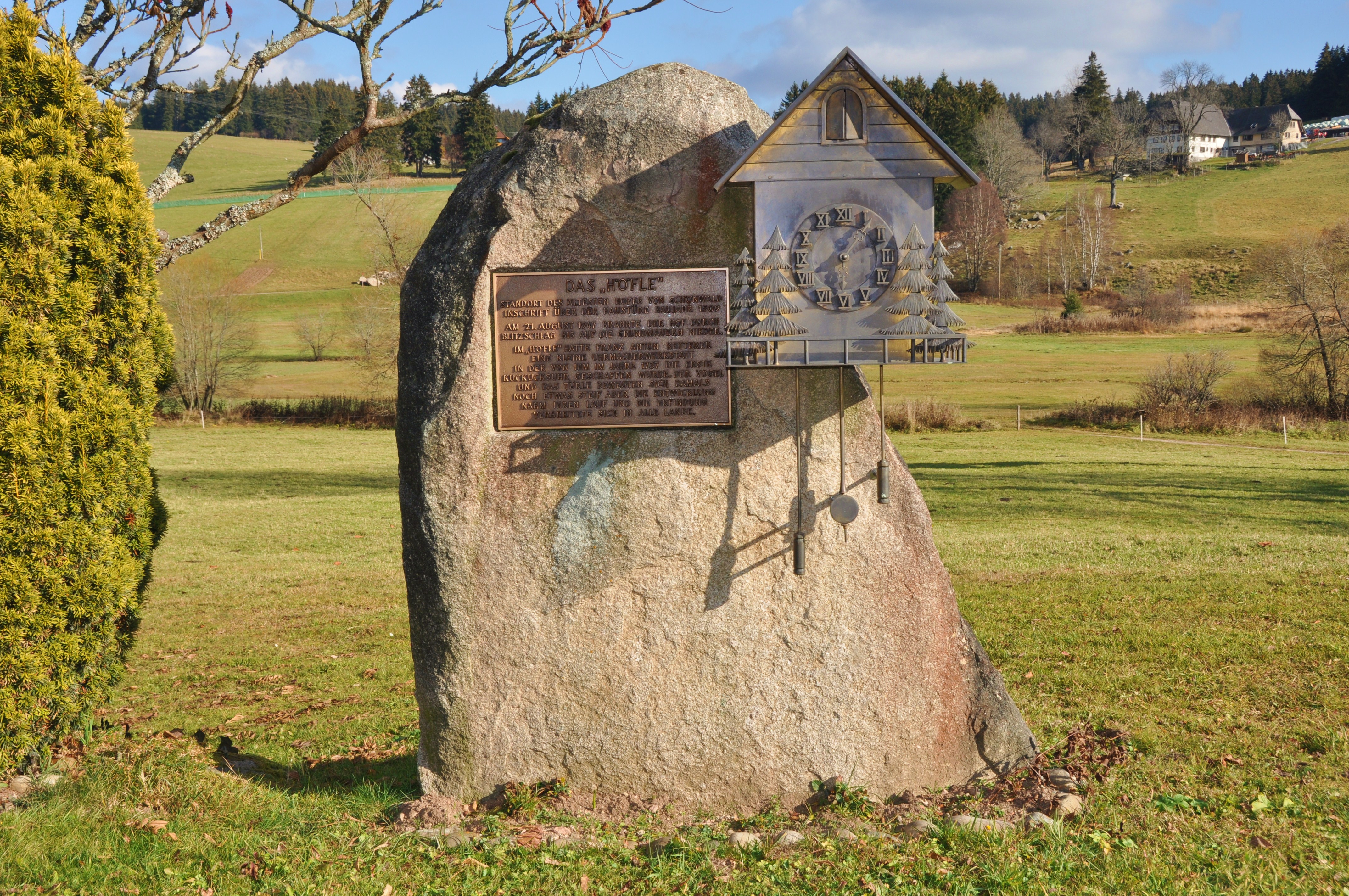
Then we headed to Schönwald, the “birthplace” of the Black Forest Cuckoo Clock. Historical reports vary, but somewhere around 1735 Franz Ketterer debuted his “invention”. A humble little monument, outside of town, is the only indicator of this man’s enormous contribution to German culture. It felt like we were in a mini-episode of Amazing Race trying to find it, but we were successful. It was strangely located in someone’s yard, between the cows and the front door, but that didn’t stop us.

Next came Triberg. Other than being the shopping-mecca of Cuckoo Clocks, this town has very little significance in the history of Black Forest clocks. We stopped in the tourist trap first. The tags were in English and even included VAT-free prices, which meant that Americans (especially military members) were a common occurrence. I knew long ago that a piece of Cuckoo Tchotchke made in China was exactly what I didn’t want, so I actually spent time looking up carvers and authentic clock makers in the Black Forest. I wanted my Cuckoo to come right from the source.

We headed to one of the locations I scouted and started looking again. The info on the web included a photo of the owner and master carver. When we were approached in the store I made the mistake of asking if he was the carver. Despite our attempts at speaking German and Joe’s beard, what this apparently really said was, “I’m an American military member…I’m a tourist…and I don’t know what I am talking about.”  Sometimes you just have to swallow your pride when you have an inkling that the end result will be beneficial. What the carver proceeded to give us as a very valuable education in clock-making and the deception of commercialism.

His lesson was based on questions: “Why are the beer-drinkers pouring the beer over their shoulders again and again instead of drinking it?” I don’t know. “Why is the dog as big as the man?” I don’t know. “As long as it says “Made In Germany,” you think it is good right?” Yes. “Wrong.”“What kind of bird does this look like?” A chicken. “Right, why would you want a chicken in your clock?” Well, actually, come to think of it, I don’t. (He then walked us to a stuffed Cuckoo bird so we knew exactly what to look for inside the clock.) “How many weights does a real clock need?” I don’t know. “Why do you want a clock that is battery operated?”  I don’t. “How can you tell if the wood was carved by hard or on a spindle?”  I can’t, but I’m sure you will tell me. “Do you think I care which one you buy, as long as I get your money?”  No, you obviously do not.

He was the epitome of German-directness. I was seeing my clock-future in a new light.

We looked around and carefully weighed all the options, inspecting the intricacies and details of every bird, beer-drinker, and clock hand.

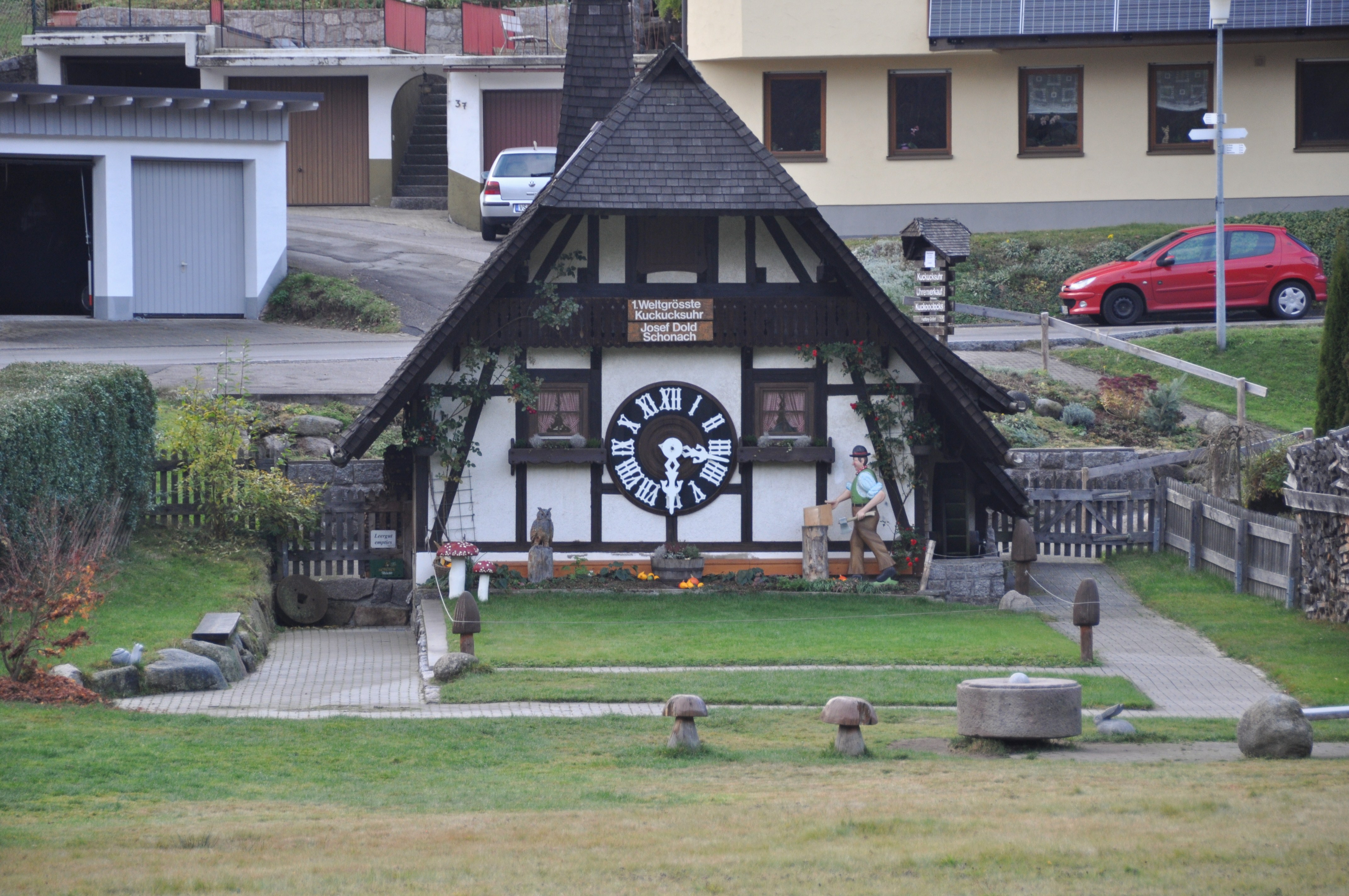
Two stops left. Next was the First World’s Biggest Cuckoo Clock in Schonach. Sadly, this was closed for a month so we had to settle with a view from the street. The World’s Biggest Cuckoo Clock in Schonachbach was the last stop. At the top of the hour, everyone lined up outside to see what would happen as the big hand hit the XII. Huge letdown, but perhaps I was expecting the Cuckoo bird to come out and put on a personal song and dance for me….and not a Chicken dance.  
 

To sum up the day, I am now the proud owner of a Black Forest Cuckoo Clock. It is big, and tacky, and noisy, and I love it!

My tip for anyone who is walking the fence about Cuckoo Clock ownership (or who has one at home against your will) is to take some time to shift your perspective. Remember that guy/girl in High School who made you think, “no thanks”, at first look? Perhaps you did a few projects or assignments together and got to know each other a bit, sharing a few laughs or inside jokes. And then, after some time, he/she didn’t look so bad anymore, right? The same phenomena will happen with Cuckoo Clocks, if you just give them a chance.

Mark Twain

I re-discovered Mark Twain on my first (and thus far only) trip to Connecticut. Perhaps when I was younger I didn’t have the insight yet to realize the wit with which Mark posed his innermost ponderings.

There have been many times in my life when a book, article, or quote presents itself with amazing relevance. Today was one of those days. It was a particularly defeating day in German class, thanks to a substitute teacher. Since my regular teacher is the only native-German speaker I can actually understand it meant that I was totally confused for most of the day.

Sharing my frustration with Joe at dinner he said that he had something he wanted me to read. It was a lengthy text describing the challenges and complexity of German. After several paragraphs, I asked where it had come from. Mark Twain, of course.

To articulate your own feelings is one thing. To have a legendary pen-man do it for you is even better.

 A very brief snippet from Appendix D from Twain’s 1880 book A Tramp Abroad.

Surely there is not another language that is so slipshod and system-less, and so slippery and elusive to the grasp. One is washed about in it, hither and thither, in the most helpless way; and when at last he thinks he has captured a rule which offers firm ground to take a rest on amid the general rage and turmoil of the ten parts of speech, he turns over the page and reads, “Let the pupil make careful note of the following exceptions.” He runs his eye down and finds that there are more exceptions to the rule than instances of it. So overboard he goes again, to hunt for another Ararat and find another quicksand. Such has been, and continues to be, my experience.

My philological studies have satisfied me that a gifted person ought to learn English (barring spelling and pronouncing) in thirty hours, French in thirty days, and German in thirty years. It seems manifest, then, that the latter tongue ought to be trimmed down and repaired. If it is to remain as it is, it ought to be gently and reverently set aside among the dead languages, for only the dead have time to learn it.

Extended text attached.Abridged Mark Twain

auf Deutsch

Who doesn’t like a good wine tasting? Freiburg is not northern California, but wine is wine right? The event was put together by our language school, who boasted that all the wines would be local to the area. There were 12 people total, including us. The levels of German proficiency were quite diverse: four beginners, at least two native speakers, and the rest were somewhere in between.

We all sat at one very long table, Joe and I at the end. The “Wine Doctor” came in and started pouring the wines and giving his presentation….alles auf Deutsch. Joe and I sat and listened and picked out words we knew or had heard before. I grabbed a “pineapple” in there somewhere, although I am not quite sure what the pineapple was supposed to be doing because I didn’t taste any in the wine.

No one said a word. No one tasted the wines. We just sat there, feeling awkward. Finally, a German-native asked if we could go ahead and taste. A sigh of relief. Three samples of white wine came and went and the chatter started to get a little louder. Out came three red-wines. As the amount of wine consumption increased, so did the conversation amongst the group, and the fluidity of speaking German.

A little bit of alcohol-induced social courage goes a long way. Thus is the theme of the rest of the evening.

I have almost finished my three red wines when I notice that the Italian sitting across from Joe has not made a dent in any of her glasses. I want to say to her: You don’t like red wine?  I think to myself, Ok, you know all these words; you know how to put the sentence together, so just ask her. I decide to try it out on Joe first, “Du magst nicht rotwein?”. He changes my nicht (negative used only with verbs) to kein (negative used only with nouns). Then I correct myself – a yes/no question has to start with the verb. Final version of the sentence: Magst du kein rotwein? I try it over several times with Joe and then finally ask her. She understands!!

She doesn’t like red wine, its too strong, and offers me her glass. I politely decline. “Nein, danke.”

So then we get to talking. Where do you live, why are you learning German, etc. Another Italian girl says that she wants to speak in English, but can only think of the words in German. I tell her that I want to speak in German, but can only think of the words in Spanish. Things are looking ok….this is a quasi-conversation….auf Deutsch!

Then Joe starts to talk. He leans in and begins to say (auf Deutsch), “My teacher says 95%……” He is interrupted from across the entire table. “Fünf und neunzig Prozent!” An intermediate speaker over hears this tid-bit and wants to know what bold statement is going to be made next. The entire table goes silent and Joe is left to make his point…auf Deutsch.

Although this is not the first time Joe has captivated a crowd, it is the first time his newly acquired German has been put on the spot. He continues. “My teacher says 95% of women don’t like beards.” How prolific. He pets the ear-to-ear growth he has been working on for a few weeks, now that he is sans a daily flight-suit. The ladies at the table begin an uproar. Some agree whole-heartedly. Others protest defiantly, “Nein, nein, nein!” So, what does Joe do? Classic move here. He goes around the table and takes a survey of which ladies like the beard and which do not…auf Deutsch!

Ironically, I am the last lady to be surveyed. They laugh that I have to like it because I am the “Frau”. I don’t even answer because I am still stuck on how we went from red wine to beards.

Next step: Dinner. We find a new place in town that we have not tried and successfully order our meal and drinks…auf Deutsch. If we butchered any words, the waitress was nice enough not to say anything. What we thought we wanted showed up at the table, so it couldn’t have been that bad. Paying for meals in Germany is interesting. You have to ask for the bill and then be ready to pay immediately. They don’t leave it on the table for you to calculate and stew over, or divide up with friends, and no one uses credit cards. So have your cash in hand!

Small tips are given as well, but only a tourist leaves money on the table. When the waiter arrives with the bill and his/her change purse, you have to decide what you want the tip to be and then ask for change from the total amount. For example, if your bill is €38,40 and you have a €50 note, you need to ask the waiter for change from €40. If you are a scrooge, there is no hiding it in German restaurants. If you don’t know your numbers…auf Deutsch…there is no hiding that either. Not a problem tonight!

Final step: Cocktails. Here is where the characters got a little interesting and the German was flowing. We order successfully and chat with each other, until the gentleman next to us starts asking questions. He goes on and on…auf Deutsch…about how he was all over the US in 1980. He asks us our ages and laughs at the responses. At least Joe was alive when he was there! He buys us two Kölsch beers because it is the best in Germany. Then he recruits another poor sap and engages in a discussion about the best beer in Germany. This guy thinks Rothaus Tannenzäpfle is the best. Here come several bottles of that!

Deep breaths, its just beer Trysta. Thank goodness Joe swapped my mostly-full bottles for his nearly-empty ones because I was struggling. The German was coming pretty easily though. I stood up on my stool and asked the bartender if he had The Captain….auf Deutsch…without even thinking about it. “Haben Sie Captain Morgen?” He laughed and said no and then returned a minute later rattling off about something. Joe thinks he asked me why I didn’t like Whiskey. He could have asked me to get up on the bar and act like The Captain for all I know. What followed was a mess of a Birthday Boy bearing “Geschenke” of more beer, a girl asking us to join someone at another bar, and a shoe-less jaunt in the Bächle.

Eventually, we reached the other side of the bell curve…auf Deutsch. Everyone was talking too fast, the articulation was getting sloppy, and we had tapped out our vocabulary. What was really funny was thinking back to what my teacher had said just that afternoon in class. He encouraged one beer while doing our homework “to loosen up the jaws”, but not three or four or five. He always asks, every Monday morning, what we did over the weekend.

How am I going to explain this…auf Deutsch?